The climate of Arunachal Pradesh varies with topography and elevation. The foothill zone is subtropical and has
a hot and humid climate; in the lower valleys, summer temperatures in June, July, and August typically rise into
the mid-90s F (mid-30s C), while winter high temperatures in December, January, and February usually reach the
mid-50s F (about 13 °C). Average temperatures decrease as elevations increase in the mountains.
Precipitation in the state generally follows the wet-dry monsoon pattern. Annual totals average about 130 inches
(3,300 mm), falling mostly between April and September during the wet southwest monsoon. In the centre of the
state, however, the precipitation figure approaches 160 inches (4,100 mm) or higher per year.
Arunachal Pradesh’s diverse terrain, climate, and soils are reflected in its fauna and flora. About two-thirds
of the state is forested, with a wide belt of swampy rainforest lying along the foothills. Forests of tropical
evergreens and subtropical pines (as well as subtropical mixed broad-leaved and pine forests) are found in lower
elevations. As elevation increases, the woodlands give way to mixed and coniferous temperate forests. Subalpine
and alpine vegetation, with rhododendrons predominating, appears on the higher slopes. A great variety of
medicinal plants, including ginseng and yew, also grow in Arunachal Pradesh, and they are used by much of the
population for the treatment and cure of various ailments.
Animal life includes tigers, clouded and snow leopards, elephants, wild buffalo, serow and goral goats, many
species of deer, and primates such as hoolock gibbons, slow lorises, macaques, and capped langurs. Animals found
at higher elevations include bharals (wild sheep), black bears, and red pandas. The rare musk deer and takin
(Budorcas taxicolor) also are found in the state. Moreover, Arunachal Pradesh has an abundance of fish, many
varieties of snakes, and hundreds of species of birds.
Arunachal Pradesh is home to dozens of distinct ethnic groups, most of which are in some ways related to the
peoples of Tibet and the hill region of western Myanmar. More than two-thirds of the state’s people are
designated officially as Scheduled Tribes, a term that generally applies to indigenous peoples who fall outside
of the prevailing Indian social structure. In western Arunachal Pradesh the Nissi (Nishi or Dafla), Sherdukpen,
Aka, Monpa, Apa Tani, and Hill Miri are among the main tribes. The Adi, who constitute the largest tribal group
in the state, live in the central region. The Mishmi inhabit the northeastern hills, and the Wancho, Nocte, and
Tangsa are concentrated in the southeastern district of Tirap. Throughout the state, the tribal peoples
generally share similar rural lifestyles and occupations; many are subsistence farmers who supplement their diet
by hunting, fishing, and gathering forest products. Dispersed villages and isolated farmsteads are typical
features of the landscape. Aside from the Scheduled Tribes, much of the remainder of the population of Arunachal
Pradesh consists of immigrants from Bangladesh, as well as from Assam, Nagaland, and other states of India.
The tribal groups speak about 50 languages and dialects, most belonging to the Tibeto-Burman branch of the
Sino-Tibetan language family. They are often mutually unintelligible; thus, Assamese and Hindi, both of which
are Indo-Aryan languages, as well as English are used as lingua francas in the region. Each of the tribes
follows its own social, cultural, and religious practices, and most are endogamous (marrying within the group).
Many of the groups practice local religions that involve interaction with various spirits and deities of nature.
Ritual sacrifice is common, and a domesticated gaur (wild ox), locally known as a mithun, is especially valued
as a sacrificial animal. Some residents of Arunachal Pradesh practice Hinduism, especially those near the
lowlands approaching the border with Assam. Tibetan Buddhism is found among groups near the Tibetan border, and
some tribes along the Myanmar border practice Theravada Buddhism, which is predominant in Southeast Asia.
Arunachal Pradesh has the lowest population density of any state in India. Most of the populace is concentrated
in the low-lying valleys, with the hill peoples living in scattered upland communities. There are no cities and
fewer than two dozen towns. Itanagar, in the southwest of Arunachal Pradesh, is the state’s largest town.
More than half of the population of Arunachal Pradesh is engaged in agriculture, but only a tiny portion of the
land is under cultivation. Although settled agriculture, including wet-rice farming, has expanded considerably
since the late 20th century, many of the hill peoples continue to practice shifting agriculture (jhum), whereby
land is cleared by burning the vegetation, is cultivated for several years, and then is abandoned in favour of
another site when the productivity of the soil declines. Rice, corn (maize), millet, and buckwheat are among the
chief crops grown by that method. Major commercial crops include oilseeds, potatoes, ginger, sugarcane, and
vegetables.
Mithuns are widely kept, and yaks are important in the higher elevations. The Monpa herd sheep. Some groups also
raise fish through aquaculture.
Arunachal Pradesh, with its abundance of forest cover, once derived a significant portion of its gross state
product from logging and forestry. Production has dropped dramatically since the 1970s, however, largely in
response to environmental legislation. In the early 21st century, forestry supported just a few local industries
of small or moderate size.
GArunachal Pradesh has significant, though largely unutilized, resource potential. Among its resources for
generating energy are rivers, coal, and petroleum; most of the state’s power is provided by hydroelectric
plants. In addition to hydrocarbons, other mineral resources of Arunachal Pradesh include dolomite, quartzite,
limestone, and marble. Efforts have been made in the early 21st century to expand hydroelectric and solar power
generation.
The state’s rugged terrain makes transport and communications extremely difficult. With few paved roads and, for
a long time, no railways in Arunachal Pradesh, links with the rest of India are limited. However, there long has
been an active trade network within the region, with footpaths connecting villages at different elevations.
Most of the major transportation centres serving Arunachal Pradesh are in the neighbouring state of Assam; among
those are the nearest airport, near Lilabari, and the nearest railhead is in Harmoti (or Harmuty). However, in
2014 a rail line was opened between Harmoti and Naharlagun. State-owned and private companies operate regular
bus service from Itanagar to various towns of Assam, including Guwahati, Tezpur, Dibrugarh, Tinsukia, and
Jorhat. Service also is available to Shillong in Meghalaya.
Telecommunications were long largely undeveloped in the state, with landline telephone service limited mainly to
the larger towns. Although basic telephone access has improved since 2000, greater progress has been made in
expanding mobile telephone service into remote mountain areas. Internet access, although still fairly limited,
has also increased in the early 21st century, including the installation of fibre-optic cables.
Arunachal Pradesh is a constituent unit of the Republic of India, and, as such, the structure of its government,
like that of most Indian states, is defined by the national constitution of 1950. The governor, appointed by
India’s president, is head of state and is aided by an elected chief minister, a Council of Ministers, and a
unicameral Legislative Assembly (Vidhan Sabha).
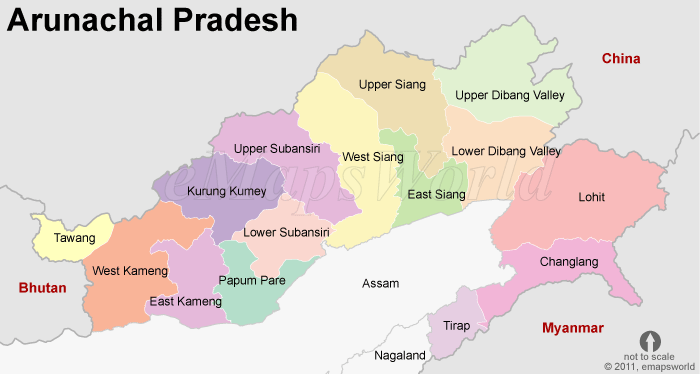
At the local level, the state comprises more than one dozen districts. In general, those districts are parceled
into a number of subdivisions, which encompass several blocks, towns, circles, and villages. Villages are the
smallest administrative units.
Arunachal Pradesh does not have its own high court. Rather, the state falls under the jurisdiction of the high
court in Guwahati, Assam. To handle cases from Arunachal Pradesh more effectively, however, a permanent bench of
the Guwahati High Court has been established at Itanagar, with a chief justice appointed by the chief justice in
Assam. Any case from Arunachal Pradesh may be referred to Guwahati, should the chief justice in Itanagar deem it
necessary.
In addition to the few general hospitals spread among the larger towns of Arunachal Pradesh, nearly every
district has its own hospital. In more remote areas, health services are provided by community health centres
and subcentres. Separate facilities specialize in homeopathic medicine. Although the rural character of
Arunachal Pradesh has remained an obstacle to the growth of the state’s hospital and health care network, the
expansion of public water works and the extension of electricity to the villages have helped to improve rural
health. By the early 21st century, roughly four-fifths of the villages had a drinking water supply and about
two-fifths were electrified.
Malaria, dengue fever, and tuberculosis are among the major health threats to the population of Arunachal
Pradesh. The state government has participated in the country’s leprosy eradication program, as well as in
national programs to control vector-borne diseases (e.g., malaria, dengue fever, and Japanese encephalitis).
Tuberculosis has remained a major concern in the state, with hospital facilities specifically designated as
tuberculosis treatment centres.
Despite the presence of numerous primary, middle, and secondary schools, the literacy rate in Arunachal Pradesh continued to rank among the lowest in India in the early 21st century. There are a number of postsecondary institutions, including Arunachal University at Itanagar, which was founded in 1984. The state also has specialized colleges focusing on such fields as education, engineering, industry, and forestry and agriculture.
Tribal peoples in Arunachal Pradesh wear distinctive garments and headdress. The art of weaving is especially
important, and textile designs are unique to each group. Dances are an integral part of community life. Losar,
Mopin, and Solung are major tribal festivals. At such festivals, villagers often drink millet or rice beer, as
well as tea.
Arunachal Pradesh has an array of notable cultural institutions, which together underscore the state’s religious
and cultural diversity. The state museum, which houses an ethnographic collection consisting of local
archaeological finds, musical instruments, weavings, carvings, and other examples of material culture, is
located in the capital, Itanagar. Also in Itanagar are the governor’s residence and a picturesque Buddhist
temple, each crowning one of the city’s two prominent peaks. A Christian revival church and temples dedicated to
the Hindu deities of Kali and Shiva are located in nearby Naharlagun. Bomdila, in the snow-clad Himalayan ranges
of the state’s western segment, has many Buddhist monasteries and hermitages, while Tawang, in the
far-northwestern extremity of Arunachal Pradesh, is famous for its 17th-century Mahayana Buddhist monastery with
gold-lettered Buddhist scriptures. Parasuramkund, on the Lohit River in the state’s eastern region, is a place
of Hindu pilgrimage where sins can be washed away in the local waters. Malinithan, in central Arunachal Pradesh,
is an archaeological site and also a place of great sanctity.
Arunachal Pradesh offers numerous parks, gardens, wildlife sanctuaries, and other natural settings for outdoor
recreation. Bhalukpung and Tipi, both in the southwest, and Bomdila all are noted for their abundant flora,
especially orchids. Namdapha National Park, near Dibrugarh on the south-central border, has a wildlife sanctuary
inhabited by tigers and leopards. In Naharlagun the botanical garden at Polo Park sits atop a ridge overlooking
the town. Other places valued for their unique scenery and natural environment are Ziro, set in a levelled
valley of west-central Arunachal Pradesh and covered on all sides by pine-clad, stooping hills, and Ganga Lake
just outside of Itanagar.